Ray
Oaxaca City, Mexico — 11/21/25
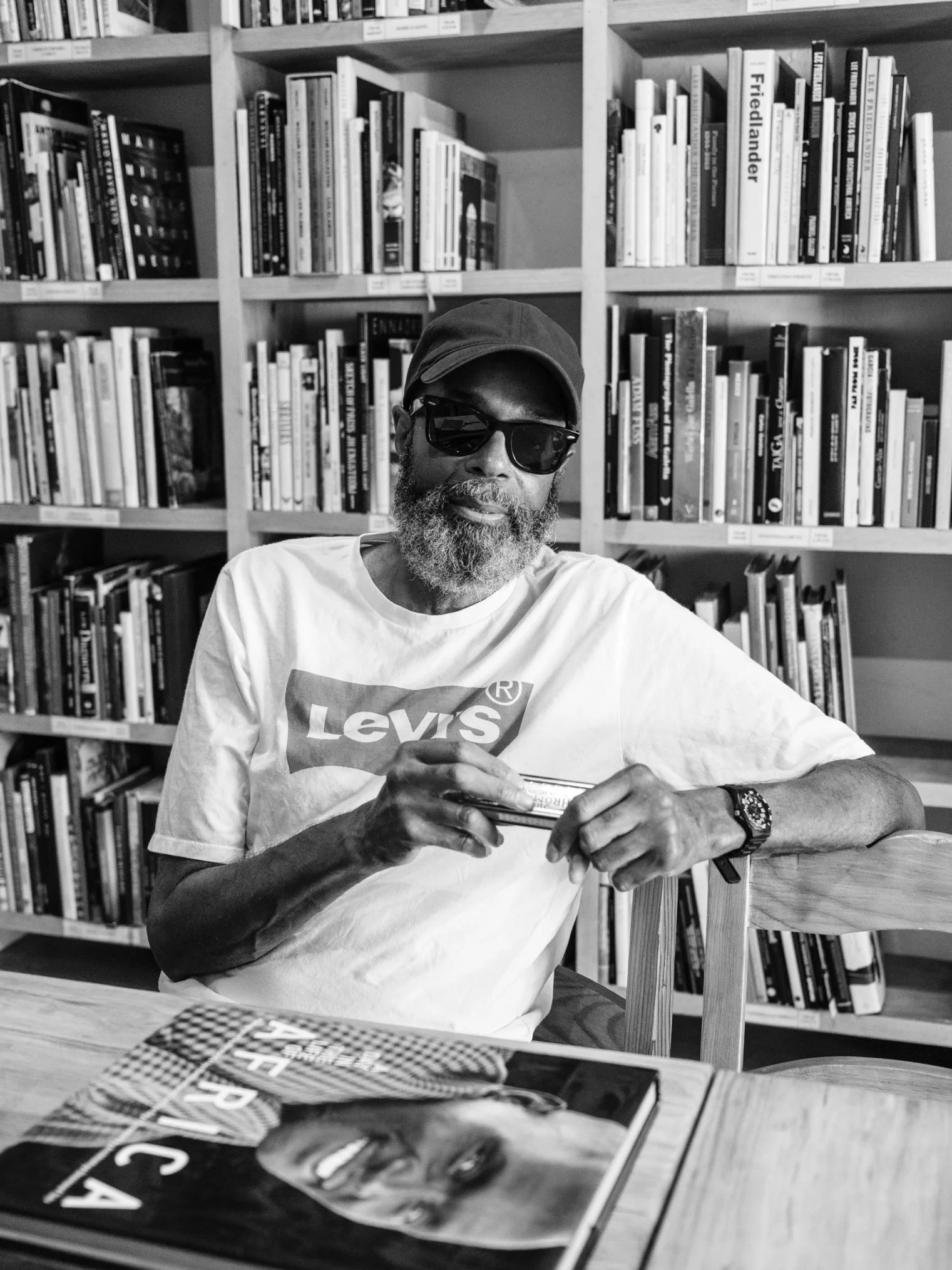
Ray, photographed in the library of the Centro Fotográfico Manuel Álvarez Bravo in Oaxaca City, Mexico.
Ray and I sit in the photography library looking at books. The Seydou Keïta book on my table, with its oversized scale and ornately patterned cover, caught his eye when he walked in and he asked if I was done with it. He’s loud in the easy, slightly obtrusive way of many Americans. He talks almost continuously as he flips through the book of portraits, mostly remarking on the photos as they pass by. He has another book of Keïta’s work at home with many of the same images but has never seen them at this scale and beauty.
Born in Missouri, raised in Los Angeles, now sheepishly living in Texas. As with so many Americans these days he almost immediately apologizes for his country and the government, as if I would blame this fellow lover of photography for the machine of terror that is U.S. politics.
This is his seventh time in Oaxaca. He loves it. The food, the art, the books. He’s a digger of poetry and literature in the city’s many bookstores. He is tall, slender, black. A crisp white T-shirt with a red Levi’s logo across the front. A stilted gate that slightly stoops his height. Seventy-one. He’s the traveler of his family. The adventurous one which extends to his taste in art, movies, music. I ask why he ended up that way, so different from the rest. Probably books he says. Reading. His family won’t even watch movies with subtitles or listen to music in other languages. He has long lists on his phone of his favourite films, photographers, harmonica players.
Now he’s looking through a big book of photos from across Africa called A Day in the Life of Africa. He was going to buy it once, somewhere along the line in a bookstore, but his wife convinced him not to. He doesn’t know why he listened to her. He rarely does.
He turns the page to a photo of a group of musicians. They’re sitting and standing on the curb of a dusty street, a light-brown, reddish building behind them. It’s bright and colourful like most of the book’s images. “Ah man,” he exclaims. “I wish I would have met these guys when I was in Africa. We would have played music together.” And as he says it his long, slender, elegant fingers slip into the front-right pocket of his jeans and pull out a long, slender, elegant case. Inside is a shiny chromatic harmonica. I don’t think I’ve ever seen one of these. Longer than blues (diatonic) or folk (tremolo) harps it has a full chromatic scale complete with sharps and flats. He tells me that all of his favourite harp players are from Europe. Masters of jazz and classical music.
Later, when I ask if I can take his portrait, he again pulls out the harp and dons sunglasses. The portrait isn’t what I had imagined. All of his American easiness vanishes and he becomes stiff. I know he would relax if he could really play the harmonica but we are in a library after all.